
Thursday 30 September 2027, the Church celebrates
Saint Jerome, Priest and Doctor of the Church
Thursday 30 September 2027 · Thursday of the 26th week in Ordinary Time · Memorial · liturgical colour: white
Saint Jerome, Priest and Doctor of the Church
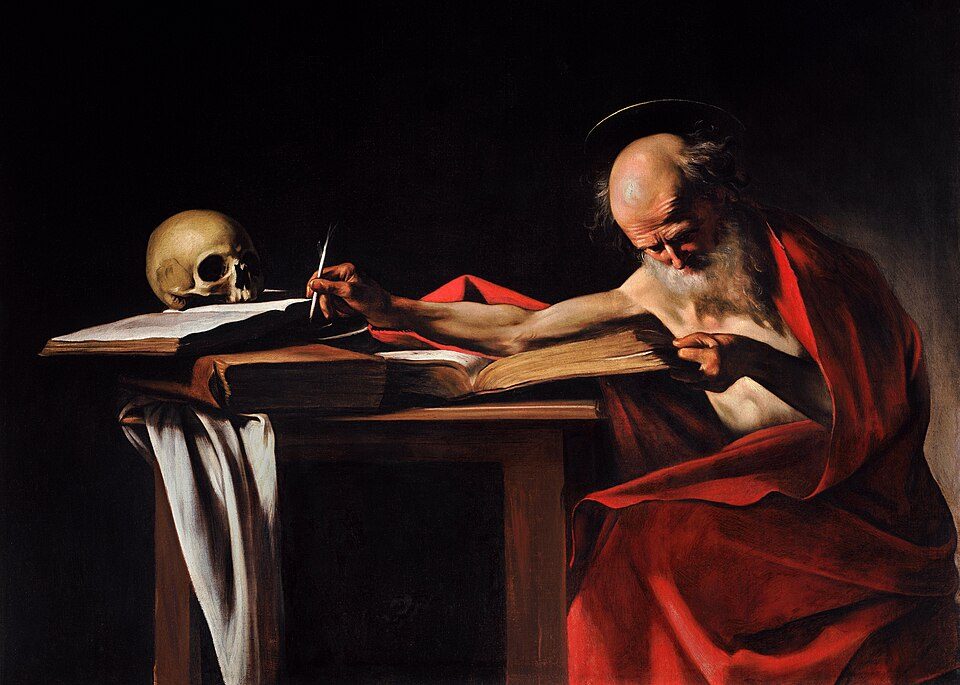

Born around 347 at Stridon, on the borders of Dalmatia, Jerome studied in Rome, where he was baptised. Drawn to monastic life, he lived as a hermit in the Syrian desert, learned Hebrew and became a priest. Back in Rome, he was secretary to Pope Damasus, who asked him to revise the Latin translation of the Gospels. He then settled in Bethlehem, where he devoted the rest of his life to translating and commenting on the Bible: his Latin translation, the Vulgate, nourished the Church for centuries. He died in Bethlehem on 30 September 420; he is the patron saint of translators.
Jerome was born around 347 at Stridon, into a Christian family that sent him to complete his studies in Rome. Baptised around 366, he turned to the ascetic life and first joined a group of fervent Christians in Aquileia. Leaving for the East, he lived as a hermit in the desert of Chalcis, in Syria: there he perfected his Greek, began the study of Hebrew and copied manuscripts.
In 382 he settled in Rome, where Pope Damasus, who knew his learning, made him his secretary and encouraged him to undertake a new Latin translation of the biblical texts. After the Pope’s death, he left Rome in 385 and settled in Bethlehem in 386. Thanks to the generosity of a noble Roman lady, Paula, a monastery for men, a monastery for women and a hostel for pilgrims were founded there.
Drawing on the Hebrew and Greek texts, Jerome, helped by collaborators, produced the Latin translation later called the “Vulgate”, which the Council of Trent would recognise as the official text of the Latin Church. To the end of his life he commented on Scripture, defended the faith with a vigour that was sometimes harsh, and welcomed pilgrims to the Holy Land. His fiery temper caused him many quarrels, but the Church admires in him a passionate love of Christ and of his Word. He died in his cell, near the Grotto of the Nativity.
A saying
“Ignorance of the Scriptures is ignorance of Christ.”
- How to recognise: He is often depicted as an old man, bent over the Bible or meditating before a skull, and dressed in red or wearing a cardinal’s hat, although he was never a cardinal. A lion accompanies him: according to legend, Jerome removed a thorn from the paw of a wounded lion.
- Patron of: He is the patron saint of translators.
- Further reading: The two catecheses that Benedict XVI devoted to him (general audiences of 7 and 14 November 2007) offer a fine way into his life and work.
Happy feast day to all named Jerome!
Sources: Nominis — Saint Jérôme · Wikipédia — Jérôme de Stridon · AELF — messe du 2027-09-30 · Benoît XVI, audience générale du 7 novembre 2007 : saint Jérôme (1) · Benoît XVI, audience générale du 14 novembre 2007 : saint Jérôme (2) · Musée du Louvre · Musée du Louvre · Palais des Beaux-Arts de Lille · Vatican News
Today's Gospel (Lk 10:1-12)
“The harvest is indeed plentiful, but the labourers are few.”
Saint Jerome devoted his life to making the Scriptures known. Like the disciples sent out by Jesus, he was a tireless labourer in the harvest.
Read all of the day's readings on aelf.org (in French)
Liturgical calendar: AELF; Gospel quotations: World English Bible (public domain)
Key
feast of one of our parish churches · today
- green: Ordinary Time
- purple: Advent and Lent
- white: Christmas, Easter, feasts of the Lord, of the Virgin Mary and of the saints
- red: the Passion, Pentecost, apostles and martyrs
- rose (optional): 3rd Sunday of Advent and 4th Sunday of Lent