
Thursday 16 September 2027, the Church celebrates
Saints Cornelius, Pope, and Cyprian, Bishop, Martyrs
Thursday 16 September 2027 · Thursday of the 24th week in Ordinary Time · Memorial · liturgical colour: red
Saints Cornelius, Pope, and Cyprian, Bishop, Martyrs
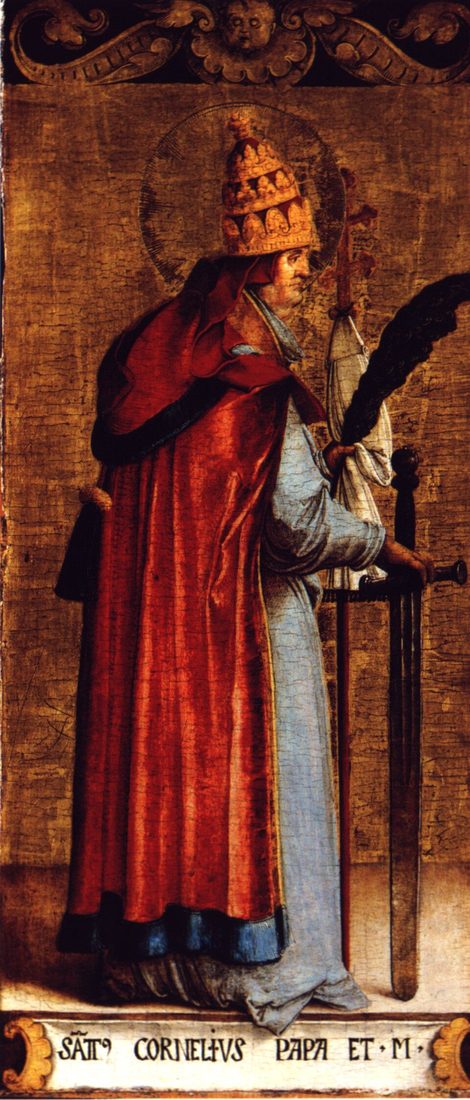

Cornelius was elected Bishop of Rome in 251, as the persecution of the Emperor Decius came to an end. With Cyprian, Bishop of Carthage, he upheld the reconciliation of Christians who had denied their faith out of fear and were asking for forgiveness, against those who wanted to reject them for ever. Cornelius died in 253. Cyprian, a former teacher of rhetoric converted as an adult, was beheaded in Carthage on 14 September 258, under the persecution of Valerian; he is one of the great witnesses to the faith of the Latin Church of the early centuries. The Church celebrates them together, united in faith and in martyrdom.
Cornelius, a Roman, was elected Pope in 251, after the See of Peter had been left vacant because of the persecution of Decius. His election was contested by Novatian, who had himself consecrated Bishop of Rome in his place and caused a schism. Under the Emperor Trebonianus Gallus, Cornelius was exiled to Civitavecchia, where he died; his body was brought back to Rome and laid in the Catacomb of Saint Callixtus.
Cyprian was born in Carthage into a wealthy pagan family; before his conversion he was a rhetorician and a lawyer. Chosen as bishop shortly after his baptism, he gave his goods to the poor and faced the persecution of Decius, the plague and divisions within his community. Exiled under Valerian, he was brought back to Carthage to be tried and put to death.
Cyprian left many letters and several treatises, notably on the unity of the Church and on the Our Father. He saw in Christ’s seamless tunic the symbol of the Church’s unity. Benedict XVI was particularly fond of his book on the Our Father, in which he stresses that this prayer is in the plural, so that no one prays only for himself.
A saying
“No one can have God as Father who does not have the Church as mother.”
- How to recognise: Saint Cornelius is often depicted as a pope, wearing the tiara and holding the papal cross; in Brittany, an ox is sometimes shown at his feet.
- Further reading: The treatises of Saint Cyprian, in particular The Unity of the Catholic Church and his commentary on the Our Father.
Sources: Nominis — Saints Corneille et Cyprien · Vatican News — Saints Corneille et Cyprien · Wikipédia — Cyprien de Carthage · Wikipédia — Corneille (pape) · Benoît XVI, audience générale du 6 juin 2007 : saint Cyprien · Plateforme ouverte du patrimoine (ministère de la Culture), notice Palissy PM56004755 : statue de saint Corneille · Plateforme ouverte du patrimoine (ministère de la Culture), notice Palissy PM56005697 : statue de saint Cornély ou saint Corneille
Today's Gospel (Lk 7:36-50)
“Therefore I tell you, her sins, which are many, are forgiven, for she loved much.”
Saints Cornelius and Cyprian defended the forgiveness granted to Christians who had faltered and then repented. The Gospel shows us Jesus forgiving the sinful woman.
Read all of the day's readings on aelf.org (in French)
Liturgical calendar: AELF; Gospel quotations: World English Bible (public domain)
Key
feast of one of our parish churches · today
- green: Ordinary Time
- purple: Advent and Lent
- white: Christmas, Easter, feasts of the Lord, of the Virgin Mary and of the saints
- red: the Passion, Pentecost, apostles and martyrs
- rose (optional): 3rd Sunday of Advent and 4th Sunday of Lent