
Friday 3 September 2027, the Church celebrates
Saint Gregory the Great, Pope and Doctor of the Church
Friday 3 September 2027 · Friday of the 22nd week in Ordinary Time · Memorial · liturgical colour: white
Saint Gregory the Great, Pope and Doctor of the Church
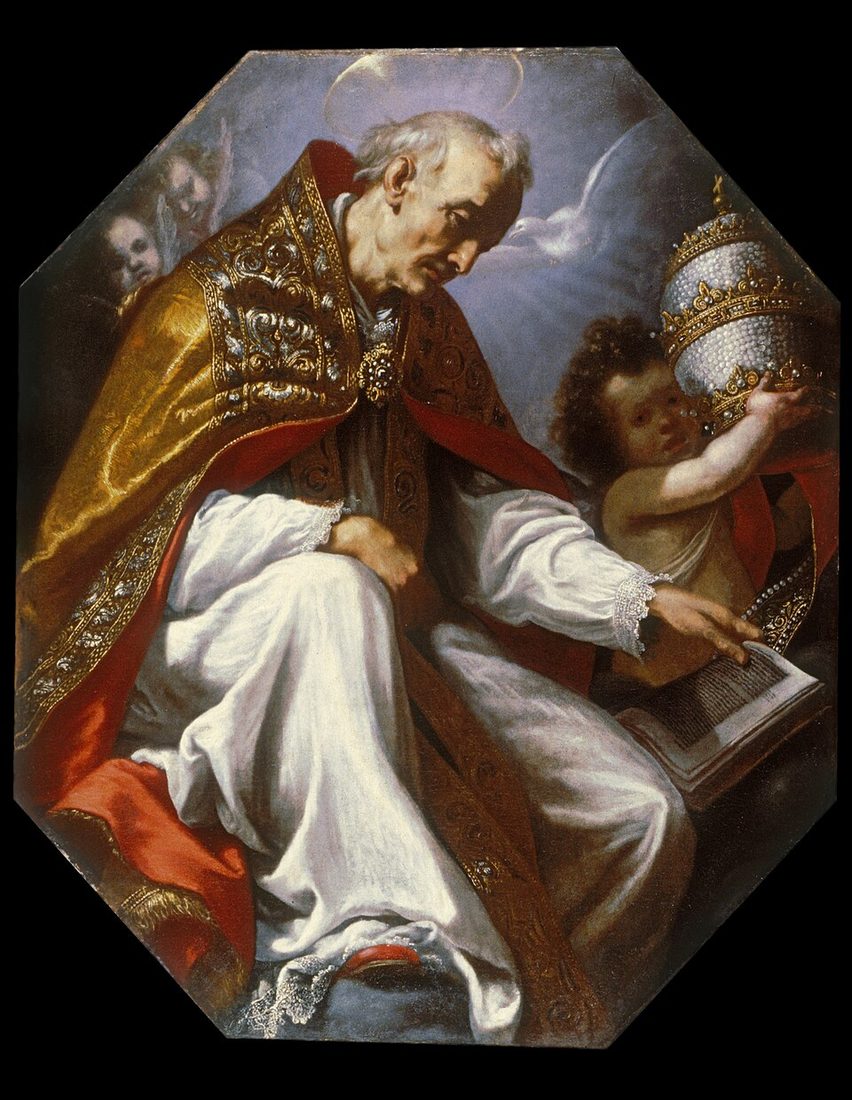

Born in Rome around 540 into a patrician family, Gregory becomes Prefect of the City before leaving everything for the monastic life. Sent by the Pope as his representative to Constantinople, he is in his turn elected Bishop of Rome in 590, while the city is stricken by plague. A pastor close to the poor, he sends monks to proclaim the Gospel in England and leaves many writings, such as the Pastoral Rule and the Dialogues. He called himself “servant of the servants of God”, a title the popes have kept. He died on 12 March 604 and is counted among the four great Doctors of the Western Church.
Gregory belongs to the Roman family of the Anicii, known for its faith; his mother, Saint Silvia, is herself venerated by the Church. After studying law, he holds high office, then gives his possessions to the poor and turns the family house on the Caelian Hill into a monastery dedicated to Saint Andrew. Sent to Constantinople by Pope Pelagius II, he stays there for about six years, continuing to live as a monk with a few brothers.
Elected Pope in 590, he faces the Lombard invasions, floods, famine and plague; he calls Rome to penance with a great procession to Saint Mary Major. According to one tradition, the Archangel Michael then appeared on the summit of Hadrian’s mausoleum, a sign of the end of the epidemic: hence, it is said, the name Castel Sant’Angelo. He has grain distributed, ransoms prisoners and negotiates peace with the Lombards.
He leaves more than eight hundred letters, homilies, a great moral commentary on the Book of Job and the Dialogues, whose second book is the main source on the life of Saint Benedict. He promotes liturgical chant, hence the name Gregorian chant. He is buried in Saint Peter’s in Rome.
A saying
“When one is pleased to have achieved many virtues, it is well to reflect on one’s own inadequacies and to humble oneself: instead of considering the good accomplished, it is necessary to consider what was neglected.”
Pastoral Rule, final chapter, quoted by Benedict XVI, General Audience of 4 June 2008
- How to recognise: He is depicted as a pope, often writing, inspired by a dove, symbol of the Holy Spirit.
- Further reading: Benedict XVI devoted two catecheses to him (General Audiences of 28 May and 4 June 2008).
Happy feast day to all named Gregory!
Sources: Nominis — Saint Grégoire le Grand · Vatican News — Saint Grégoire le Grand · Wikipedia — Grégoire Ier · Benoît XVI, audience générale du 4 juin 2008 : Grégoire le Grand (2) · Benoît XVI, audience générale du 28 mai 2008 · POP (ministère de la Culture)
Today's Gospel (Lk 5:33-39)
“But new wine must be put into fresh wineskins”
Saint Gregory, a monk who became Pope, united prayer and the service of the Church. With him, let us welcome the newness of the Gospel, the new wine that Jesus offers us.
Read all of the day's readings on aelf.org (in French)
Liturgical calendar: AELF; Gospel quotations: World English Bible (public domain)
Key
feast of one of our parish churches · today
- green: Ordinary Time
- purple: Advent and Lent
- white: Christmas, Easter, feasts of the Lord, of the Virgin Mary and of the saints
- red: the Passion, Pentecost, apostles and martyrs
- rose (optional): 3rd Sunday of Advent and 4th Sunday of Lent