
Tuesday 8 June 2027, the Church celebrates
Saint Gildard and Saint Medard
Tuesday 8 June 2027 · Tuesday of the 10th week in Ordinary Time · liturgical colour: green
In our parish
- Saint Gildard, Bishop: Église Saint-Gildard de Longuesse
- Saint Medard, Bishop: Église Saint-Médard de Vigny
Saint Gildard, Bishop


Gildard, also called Godard, was Bishop of Rouen at the beginning of the 6th century, in the time of Clovis. He took part in the Council of Orléans in 511. According to tradition, he was born at Salency, in Picardy, and is said to have been the twin brother of Saint Medard, celebrated on the same day. His relics are said to have been taken in the 9th century to the Abbey of Saint-Médard in Soissons. The church of Longuesse is dedicated to him.
What is known of Gildard, also called Godard, rests mainly on late accounts. According to tradition, he was born at Salency, in Picardy, and is said to have been the twin brother of Saint Medard. As Bishop of Rouen, he took part in the Council of Orléans in 511.
In Rouen, at the end of the 11th century, Archbishop William Bonne-Âme instituted an annual procession to the former church of Saint-Romain, where Godard was believed to have been buried; this church took the name of Saint-Godard. His relics are said to have later been taken to the Abbey of Saint-Médard in Soissons.
- Further reading: In our parish, the church of Longuesse is dedicated to him; in Rouen, the church of Saint-Godard bears his name.
Happy feast day to all named Godard!
Sources: Nominis (Conférence des évêques de France) — Saint Godard · Wikipedia — Godard de Rouen · POP (ministère de la Culture)
Saint Medard, Bishop
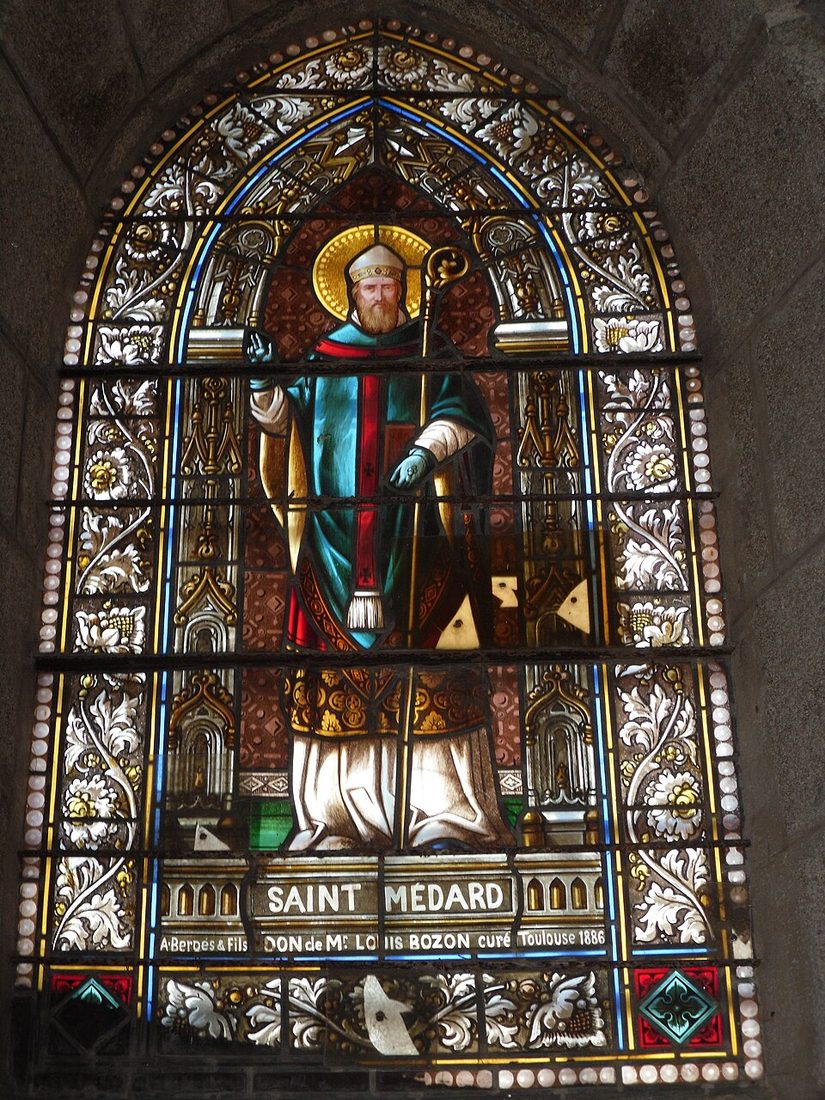

Medard was born around 456 at Salency, in Picardy. Having become a priest and then Bishop of the Vermandois, he moved his see to Noyon, a better-protected town, and strove to turn the people away from pagan superstitions. He consecrated to God Queen Saint Radegund, who had left the court. His kindness to the poor has remained famous: it is said that, as a child, he gave his new clothes to a blind beggar. He died in the 6th century and has also given his name to popular weather sayings about rain. The church of Vigny is dedicated to him.
Born around 456 at Salency, near Noyon, into a Frankish family, Medard studied at Vermand and Tournai. Noticed by Alomer, Bishop of Vermand, he was ordained a priest in 489. Having become Bishop of the Vermandois, he moved his see to the fortified town of Noyon.
The ancient accounts remember above all his kindness: he gave generous alms and, it is said, never wanted to punish the thieves who plundered his beehives or his orchard. A missionary bishop, he strove to turn the people away from pagan superstitions and lead them to Christ. His feast, on 8 June, gave rise to the well-known French saying: if it rains on that day, it will rain for forty days afterwards, unless Saint Barnabas “cuts the grass from under his feet”.
- Patron of: He is the patron saint of farmers and brewers, and he is invoked for rain or for fine weather.
- Further reading: In our parish, the church of Saint-Médard in Vigny is dedicated to him.
Happy feast day to all named Medard!
Sources: Nominis (Conférence des évêques de France) — Saint Médard de Noyon · Wikipedia — Médard de Noyon
Today's Gospel (Mt 5:13-16)
“You are the light of the world.”
Jesus calls his disciples to be the salt of the earth and the light of the world. Saint Gildard and Saint Medard, patron saints of the churches of Longuesse and Vigny, were this light for their time.
Read all of the day's readings on aelf.org (in French)
Liturgical calendar: AELF; Gospel quotations: World English Bible (public domain)
Key
feast of one of our parish churches · today
- green: Ordinary Time
- purple: Advent and Lent
- white: Christmas, Easter, feasts of the Lord, of the Virgin Mary and of the saints
- red: the Passion, Pentecost, apostles and martyrs
- rose (optional): 3rd Sunday of Advent and 4th Sunday of Lent