
Monday 8 February 2027, the Church celebrates
Saint Jerome Emiliani
Monday 8 February 2027 · Monday of the 5th week in Ordinary Time · Optional memorial · liturgical colour: green
Saint Jerome Emiliani
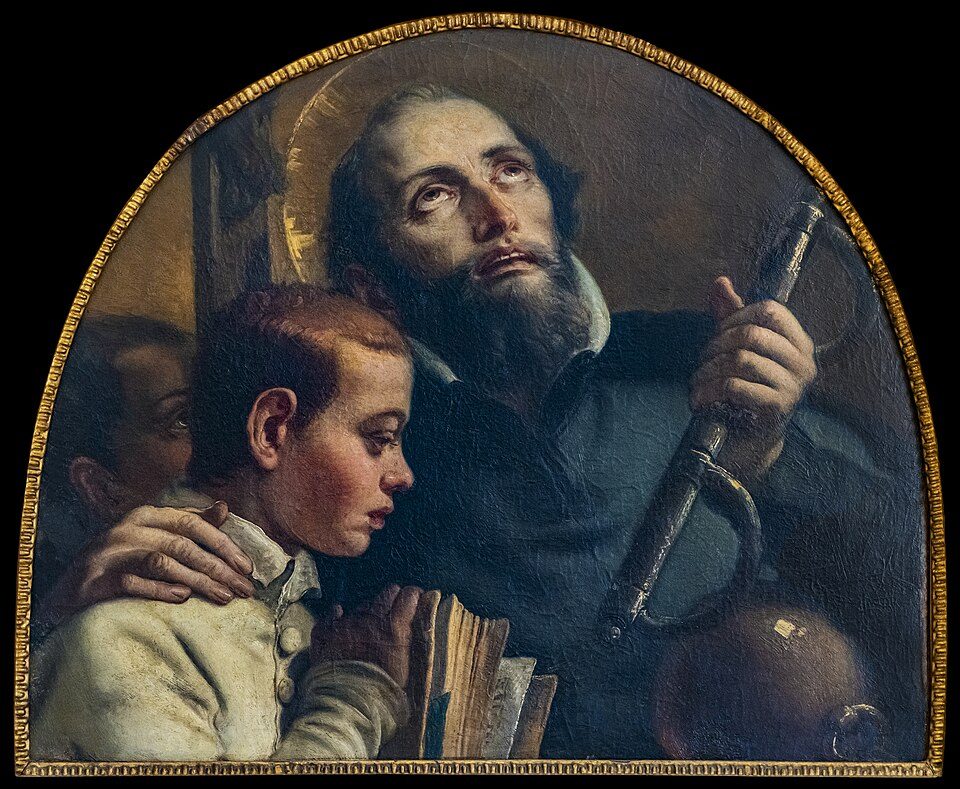

Jerome Emiliani is born in Venice in 1486 into a noble family and first takes up a military career. Taken prisoner, he is converted and decides to devote his life to the poorest, especially orphans and the sick. With companions he founds at Somasca, in Lombardy, a community from which the Clerks Regular of Somasca were born. He dies in 1537 of the plague, contracted while caring for the sick.
Born into a noble Venetian family, Jerome Emiliani first chooses the profession of arms, like many young Venetians of his time, and leads a dissolute youth. In 1511, at the siege of Castelnuovo di Quero, he is taken prisoner. In captivity he turns to the Virgin Mary and promises her to change his life; once free, he keeps his word, entrusts himself to a priest and begins to read the Bible.
From then on he devotes himself to the sick and the destitute, to whom he gives his possessions, and takes in orphans, beginning with his brother’s children. With companions, he creates a school for them where they learn a trade, along with the catechism and prayer. From this work is born the Company of the Servants of the Poor, which will become the congregation of the Clerks Regular of Somasca, named after the Lombard village where he settled.
Stricken with the plague while caring for the sick, he dies at Somasca, near Bergamo, during the night of 7 to 8 February 1537. Canonised in 1767, he was proclaimed by Pope Pius XI in 1928 universal patron of orphans and abandoned young people. His spiritual sons, the Somascans, venerate the Virgin Mary as “Mother of Orphans”.
A saying
“God does not accomplish his work in those who will not place all their faith and all their hope in him.”
- Patron of: He is the patron saint of orphans and abandoned young people.
- Further reading: Somasca, near Bergamo, where he founded his community and where he died, remains the cradle of the Somascans.
Sources: Nominis (Église catholique en France) · Wikipédia · Vatican News — Saint Jérôme Émilien, fondateur des Clercs réguliers de Somasque · Jean-Paul II, lettre aux Clercs réguliers de Somasque (11 janvier 1986, en italien)
Saint Josephine Bakhita, Virgin
Bakhita was born around 1869 in Darfur, in Sudan. Kidnapped as a child, she is sold several times as a slave and suffers terrible ill-treatment. Having reached Italy and been freed, she becomes a Christian, then a religious sister, and spends the rest of her life serving everyone in Schio, near Vicenza, where she dies on 8 February 1947. She was canonised in 2000.
Kidnapped at about the age of nine by slave traders, the little girl is so terrified that she forgets even her own name; her captors call her “Bakhita”, meaning “the lucky one”. Sold several times in the markets of Sudan, she is beaten and mutilated, and bears the scars all her life. She is finally bought by the Italian consul in Khartoum, who treats her humanely.
When the consul has to return to Italy as the Mahdist insurgents advance, she begs him to take her with him. Then entrusted to a family in the Veneto, whose little daughter she looks after, she is taken in for a time by the Canossian Sisters in Venice, where she discovers Christ. She then understands that above all the masters who had mistreated her there is a Lord who knows her and loves her. On 9 January 1890 she receives baptism, confirmation and First Communion from the hands of the Patriarch of Venice, with the name Josephine.
She takes her vows with the Canossians on 8 December 1896, in Verona. At the convent in Schio she is in turn cook, sacristan and portress, and her gentleness wins her the affection of the townspeople, who call her “Moretta”, the “little dark one”, or “the Black Mother”. She would say that, without the trials of her youth, she would never have become a Christian and a religious sister.
A saying
“Through the knowledge of this hope she was “redeemed”: she no longer felt herself a slave, but a free daughter of God.”
- Further reading: Her body rests in Schio, near Vicenza, in the Church of the Holy Family, a shrine next to the Canossian convent.
Happy feast day to all named Josephine, Bakhita!
Sources: Nominis (Église catholique en France) · Wikipédia · Benoît XVI — Encyclique Spe salvi (2007), n. 3 · Vatican News — Sainte Joséphine Bakhita, vierge · Visit Schio (ville de Schio) : église de la Sainte-Famille, sanctuaire de sainte Joséphine Bakhita
Today's Gospel (Mk 6:53-56)
“As many as touched him were made well.”
The sick seek to touch Jesus; Jerome Emiliani made himself the servant of orphans and the sick, and Josephine Bakhita, freed from slavery, humbly served everyone she met.
Read all of the day's readings on aelf.org (in French)
Liturgical calendar: AELF; Gospel quotations: World English Bible (public domain)
Key
feast of one of our parish churches · today
- green: Ordinary Time
- purple: Advent and Lent
- white: Christmas, Easter, feasts of the Lord, of the Virgin Mary and of the saints
- red: the Passion, Pentecost, apostles and martyrs
- rose (optional): 3rd Sunday of Advent and 4th Sunday of Lent