
Wednesday 20 January 2027, the Church celebrates
Saint Fabian, Pope and Martyr
Wednesday 20 January 2027 · Wednesday of the 2nd week in Ordinary Time · Optional memorial · liturgical colour: green
Saint Fabian, Pope and Martyr
Fabian was a simple layman when he was chosen as Bishop of Rome in 236. For fourteen years he organises the Church of Rome with wisdom. He dies a martyr in 250, during the persecution of the Emperor Decius, and is buried in the Catacombs of Callixtus, on the Appian Way.
A layman, Fabian was called to the pontificate, says the Roman Martyrology, “by divine disposition”. A Roman, he succeeds Pope Anterus in 236, and his fourteen-year pontificate coincides with a period of religious peace.
A good administrator, he divides Rome into seven ecclesiastical regions, notably for the care of the poor, and maintains relations with the Churches of the East. Saint Cyprian of Carthage, his contemporary, regarded him as an incomparable man. He dies a martyr in 250, at the beginning of the persecution of Decius. His tombstone, bearing his name in Greek, was found in the 19th century in the Crypt of the Popes in the Catacomb of Saint Callixtus.
- Further reading: In Rome, the Crypt of the Popes in the Catacomb of Saint Callixtus, on the Appian Way, preserves the memory of his burial.
Happy feast day to all named Fabian, Fabienne!
Sources: Nominis (Église catholique en France) · Wikipédia · Vatican News : saints du 20 janvier · Catacombes de Saint-Calixte : la crypte des Papes
Saint Sebastian, Martyr
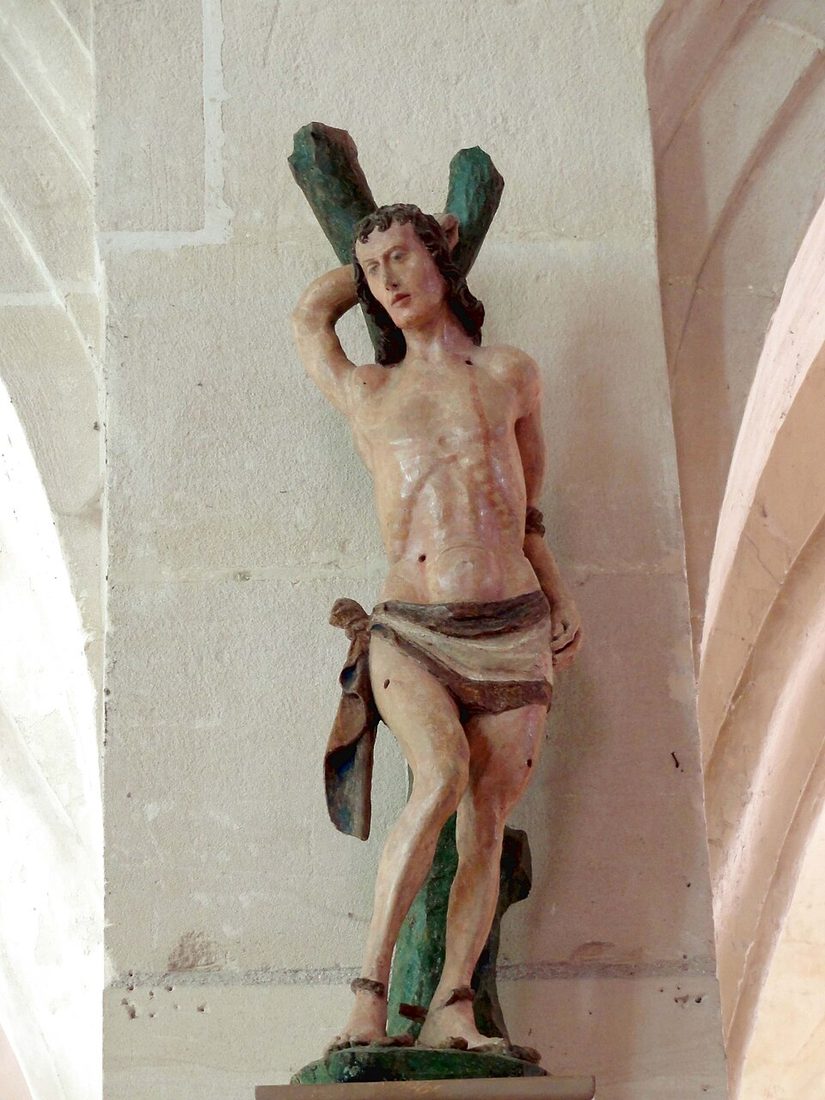

Sebastian is one of the most famous martyrs of Rome. Saint Ambrose reports that he came from Milan and that he went to Rome at the time of the persecutions. According to tradition, he was an officer in the imperial army; discovered to be a Christian, he was tied to a tree and pierced with arrows, then put to death. He was buried in the catacombs on the Appian Way.
Reliable historical details about Sebastian are rare. His cult goes back to the 4th century: Saint Ambrose, Bishop of Milan, mentions him in his commentary on Psalm 118. The Roman Martyrology records that he suffered martyrdom in Rome, a city to which he had come as a stranger.
The detailed account of his passion was not written until the 5th century. It relates that, as an officer in Diocletian’s army, Sebastian refused to sacrifice to the emperor when his faith was discovered. According to this account, he was used as a target by his own soldiers, then finished off with blows from clubs. Pope Saint Damasus had a church built over his tomb.
His cult spread widely. In the Middle Ages he was invoked against the plague: the rapid spread of the epidemic was compared to the arrows of an archer. In France, a great many churches are placed under his patronage.
- How to recognise: He is most often depicted tied to a tree or a post and pierced with arrows; in the early Middle Ages he was more usually shown as an older man.
- Patron of: He is the patron saint of archers, soldiers and athletes; he is also invoked against plague and epidemics.
- Further reading: In Rome, on the Appian Way, the Basilica of Saint Sebastian stands above the catacombs where he was buried.
Happy feast day to all named Sebastian, Bastien!
Sources: Nominis (Église catholique en France) · Wikipédia · Aleteia — Pourquoi saint Sébastien est-il le patron des athlètes ? · Aleteia — Pourquoi saint Sébastien est lui aussi invoqué contre les épidémies ?
Today's Gospel (Mk 3:1-6)
“Is it lawful on the Sabbath day to do good or to do harm? To save a life or to kill?”
Faced with hostility, Jesus chooses to do good; Fabian and Sebastian also chose Christ to the very end.
Read all of the day's readings on aelf.org (in French)
Liturgical calendar: AELF; Gospel quotations: World English Bible (public domain)
Key
feast of one of our parish churches · today
- green: Ordinary Time
- purple: Advent and Lent
- white: Christmas, Easter, feasts of the Lord, of the Virgin Mary and of the saints
- red: the Passion, Pentecost, apostles and martyrs
- rose (optional): 3rd Sunday of Advent and 4th Sunday of Lent