
Thursday 31 December 2026, the Church celebrates
Saint Sylvester I, Pope
Thursday 31 December 2026 · Thursday, 7th day in the Octave of Christmas · Optional memorial · liturgical colour: white
Saint Sylvester I, Pope
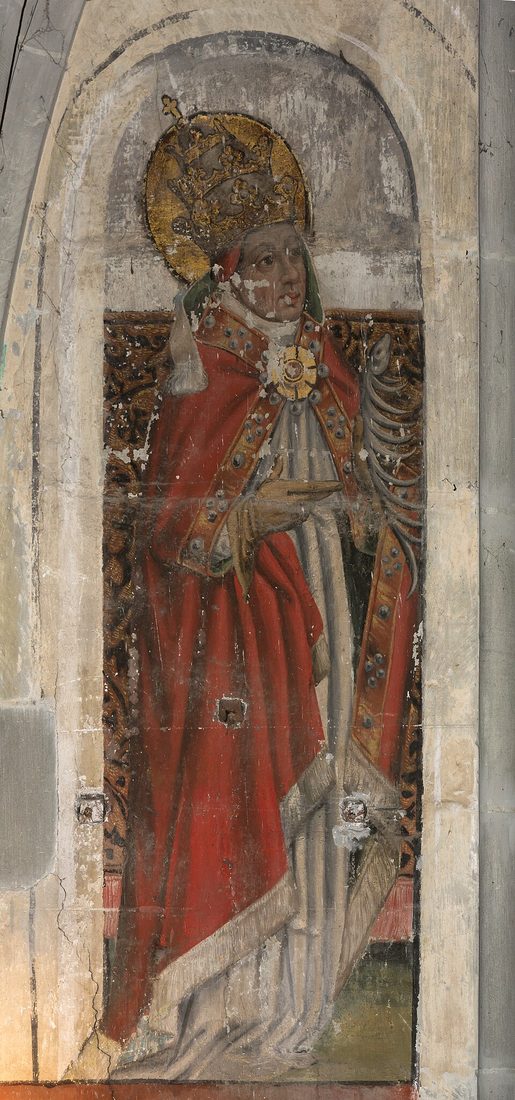

Sylvester was Pope from 314 to 335, during the reign of the Emperor Constantine, when the Church had just regained peace after the persecutions. This was the time when the first great basilicas were built in Rome, such as Saint John Lateran, and when the Council of Nicaea, in 325, proclaimed faith in Christ the Son of God. He did not attend in person, but was represented there. Many legends were written about him later. He died in 335 and was buried on 31 December in the cemetery of Priscilla, in Rome.
According to the Liber pontificalis, Sylvester was the son of a Roman named Rufinus; a priest of Rome, he became Pope in 314. The year before, the Emperors Constantine and Licinius had granted Christians freedom of worship: he was thus the first Pope of a Church that no longer had to hide. His task was to organise the Church in a society that was at last at peace.
During his pontificate, Constantine had great basilicas built in Rome: the Lateran and its baptistery, Holy Cross in Jerusalem, Saint Paul Outside the Walls and, according to the Liber pontificalis, the first Saint Peter’s Basilica in the Vatican. Sylvester took care of the liturgical furnishings and vestments, and had the catacombs laid out. He attended neither the Council of Arles, in 314, nor that of Nicaea, both convened by the emperor, but had himself represented at them.
At his death, he was immediately honoured in Rome as a “confessor”: he is one of the first saints venerated without having suffered martyrdom. From the 5th century onwards, legendary accounts, the “Acts of Sylvester”, attributed to him the baptism of Constantine; they later served as the basis for a famous forgery, the “Donation of Constantine”. These accounts are now recognised as legendary.
- How to recognise: Artists have often depicted him baptising the Emperor Constantine, a scene taken from the legend, for example in the Hall of Constantine in the Vatican Museums.
- Patron of: He gave his name to the Order of Saint Sylvester, one of the three orders of knighthood conferred by the Holy See.
- Further reading: The Basilica of Saint John Lateran, the Pope’s cathedral in Rome, was built during his pontificate.
Happy feast day to all named Sylvester!
Sources: Nominis (Conférence des évêques de France) · Vatican News · Wikipédia · Catholic Encyclopedia (New Advent) — Pope St. Sylvester I · Musées du Vatican — Baptême de Constantin (salle de Constantin)
Today's Gospel (Jn 1:1-18)
“The Word became flesh and lived amongst us.”
On the last day of the year, the Gospel tells again the mystery of Christmas: God came to dwell among us. Saint Sylvester guided the Church at the time when, at the Council of Nicaea, she proclaimed her faith in Christ, the Son of God.
Read all of the day's readings on aelf.org (in French)
Liturgical calendar: AELF; Gospel quotations: World English Bible (public domain)
Key
feast of one of our parish churches · today
- green: Ordinary Time
- purple: Advent and Lent
- white: Christmas, Easter, feasts of the Lord, of the Virgin Mary and of the saints
- red: the Passion, Pentecost, apostles and martyrs
- rose (optional): 3rd Sunday of Advent and 4th Sunday of Lent