
Monday 7 December 2026, the Church celebrates
Saint Ambrose, Bishop and Doctor of the Church
Monday 7 December 2026 · Monday of the 2nd week of Advent · Memorial · liturgical colour: white
Saint Ambrose, Bishop and Doctor of the Church
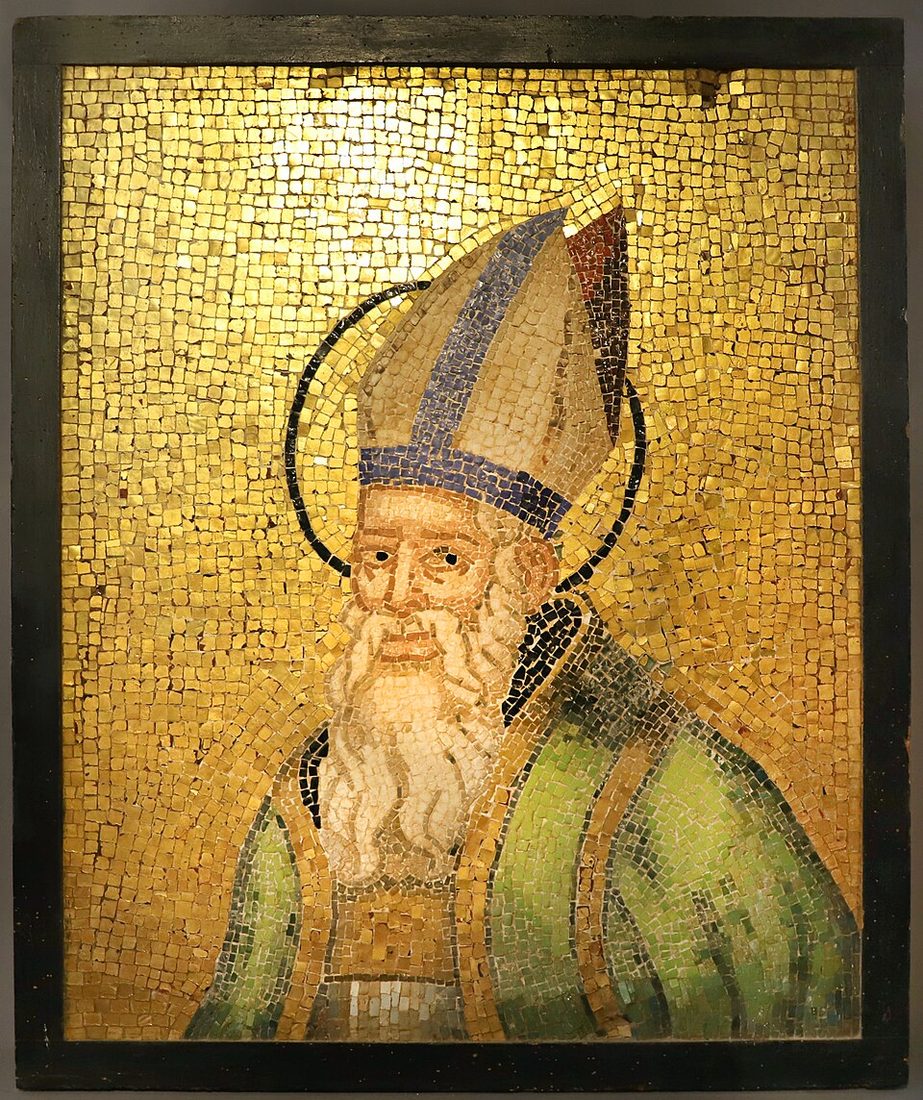

Born in Trier around 339, Ambrose became a senior Roman official and was governing the region of Milan when, in 374, the people demanded him as their bishop although he was still only a catechumen. Baptised and then ordained, he gave himself wholly to his office: a defender of the faith of Nicaea against Arianism, a tireless preacher full of charity towards all, he did not hesitate to demand penance from the Emperor Theodosius. His preaching contributed to the conversion of Saint Augustine. He composed hymns still sung today and died in Milan in 397. He is one of the great Doctors of the Western Church and the patron saint of beekeepers.
Ambrose was born in Trier into a Christian Roman family: his father was Prefect of the Gauls. After studying law and rhetoric in Rome, he entered the imperial administration and became governor of the province of Aemilia and Liguria, whose seat was Milan. In 374, on the death of the Arian bishop Auxentius, the election of his successor divided the city; having come to restore calm, Ambrose heard, according to the ancient account, a child’s voice cry out “Ambrose for bishop!”, at once taken up by the whole assembly.
Having become bishop, he gave his goods to the poor and set himself to the diligent study of the Scriptures, drawing in particular on Origen. He brought lectio divina, the prayerful reading of the Bible, into the Latin West; the young Augustine was astonished to see him read the Scriptures in silence, whereas people usually read aloud. In 390, after the massacre ordered at Thessalonica by the Emperor Theodosius, he required public penance of him before admitting him to church again. To support his people’s prayer, he introduced the singing of hymns into the West, some of which, such as “Aeterne rerum Conditor”, are still sung.
He died in Milan during the night of 3 to 4 April 397; according to Benedict XVI, his arms stretched out in the form of a cross expressed his sharing in the death and resurrection of the Lord. It was he who had baptised Saint Augustine during the Easter Vigil of 387. He is counted among the four great Doctors of the Western Church, with Saint Augustine, Saint Jerome and Saint Gregory the Great.
A saying
“Omnia Christus est nobis! If you have a wound to heal, he is the doctor; […] if you fear death, he is life; if you desire Heaven, he is the way; if you are in the darkness, he is light...”
De virginitate, 16.99, quoted by Benedict XVI, General Audience of 24 October 2007
- How to recognise: He is depicted as a bishop, with mitre and crozier; as patron saint of beekeepers, he is sometimes shown with a woven straw beehive.
- Patron of: He is the patron saint of beekeepers and of the technical and administrative corps of the French armed forces.
- Further reading: His body rests in Milan, in the Basilica of Saint Ambrose.
Happy feast day to all named Ambrose!
Sources: Nominis (Conférence des évêques de France) · Vatican News · Wikipedia · Benoît XVI, audience générale du 24 octobre 2007 (vatican.va) · Basilique Saint-Ambroise de Milan — Ambrogio vescovo
Today's Gospel (Lk 5:17-26)
“Man, your sins are forgiven you.”
Jesus forgives the paralysed man and raises him up. Saint Ambrose, a shepherd full of charity, also helped many people, among them Saint Augustine, to get back on their feet and return to God.
Read all of the day's readings on aelf.org (in French)
Liturgical calendar: AELF; Gospel quotations: World English Bible (public domain)
Key
feast of one of our parish churches · today
- green: Ordinary Time
- purple: Advent and Lent
- white: Christmas, Easter, feasts of the Lord, of the Virgin Mary and of the saints
- red: the Passion, Pentecost, apostles and martyrs
- rose (optional): 3rd Sunday of Advent and 4th Sunday of Lent