
Tuesday 17 November 2026, the Church celebrates
Saint Elizabeth of Hungary
Tuesday 17 November 2026 · Tuesday of the 33rd week in Ordinary Time · Memorial · liturgical colour: white
Saint Elizabeth of Hungary
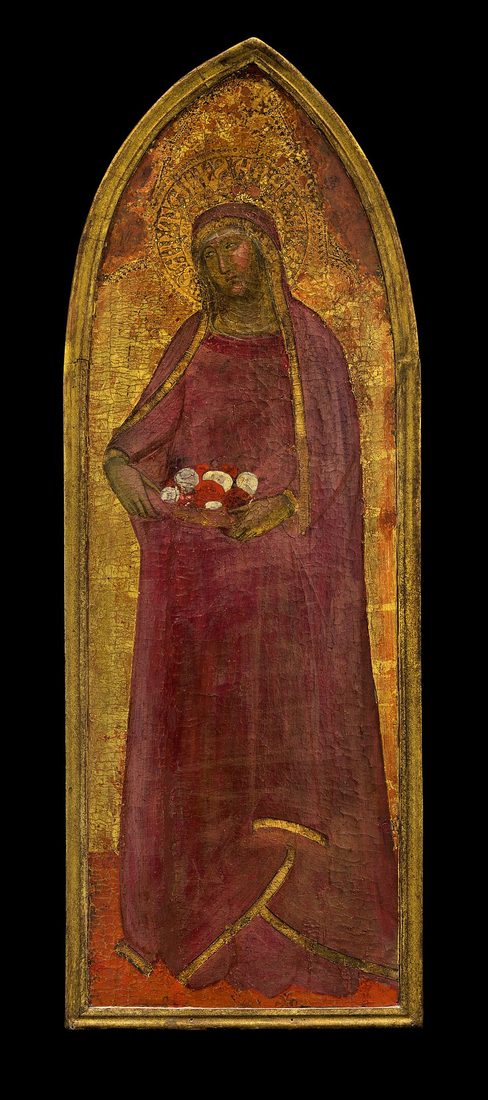

The daughter of King Andrew II of Hungary, Elizabeth was born in 1207 and at fourteen married Louis, Landgrave of Thuringia, in Germany; their marriage was a happy one, and together they helped the poor. In 1227 Louis died in Italy as he was setting out on crusade: widowed at twenty, Elizabeth entered the Franciscan Third Order. In Marburg she founded a hospital, where she spent her last years serving the most neglected of the sick. She died in Marburg in November 1231, aged twenty-four. Canonised as early as 1235 by Pope Gregory IX, she is the patron saint of the Franciscan Third Order.
Elizabeth was only four when she left the Hungarian court for Thuringia, in central Germany, where she was promised to the Landgrave’s son. She grew up at Wartburg Castle and received a careful education there. This marriage, arranged for political reasons, became a true love story, nourished by the faith of both spouses, who had three children.
Elizabeth found the luxury of the court hard to bear: one day, on the feast of the Assumption, she laid her crown before the crucifix, not wishing to wear it before Christ crowned with thorns. She went to the poor herself, brought them bread and clothing, and cared for the sick, with her husband’s support. Tradition relates that one day, surprised by him with her apron full of bread for the poor, she opened it and found only roses inside. The Franciscan friars, newly arrived in Germany, introduced her to the spirit of poverty of Saint Francis.
After Louis’s death, her brother-in-law seized power and drove her out of the castle with her children: she then knew humiliation and poverty. On Good Friday 1228, she solemnly renounced her own will and the vanities of the world. Withdrawing to Marburg, she spent her last three years in the hospital she had founded, choosing the humblest tasks. In November 1231, struck down by high fevers, she asked to remain alone with God and fell gently asleep in the Lord.
A saying
“How can I, a wretched creature, continue to wear a crown of earthly dignity, when I see my King Jesus Christ crowned with thorns?”
Elizabeth’s reply to her mother-in-law, quoted by Benedict XVI, General Audience of 20 October 2010
- How to recognise: She is often depicted with roses, or with loaves turned into roses, in memory of the “miracle of the roses”.
- Patron of: She is the patron saint of the Third Order Regular of Saint Francis and of the Secular Franciscan Order.
- Further reading: In Marburg, Germany, the Church of Saint Elizabeth, built in her honour after her canonisation, in 1235.
Happy feast day to all named Elizabeth!
Sources: Nominis — Sainte Élisabeth de Thuringe (de Hongrie) · Benoît XVI — Audience générale du 20 octobre 2010 : sainte Élisabeth de Hongrie · Vatican News — Saints du 17 novembre · Wikipédia — Élisabeth de Hongrie · Diocèse de Tournai : Identifier un saint (attributs)
Today's Gospel (Lk 19:1-10)
“For the Son of Man came to seek and to save that which was lost.”
Zacchaeus gives half of his possessions to the poor after welcoming Jesus. Saint Elizabeth, a princess who became a servant of the sick, also lived out this joyful sharing.
Read all of the day's readings on aelf.org (in French)
Liturgical calendar: AELF; Gospel quotations: World English Bible (public domain)
Key
feast of one of our parish churches · today
- green: Ordinary Time
- purple: Advent and Lent
- white: Christmas, Easter, feasts of the Lord, of the Virgin Mary and of the saints
- red: the Passion, Pentecost, apostles and martyrs
- rose (optional): 3rd Sunday of Advent and 4th Sunday of Lent